Key Takeaway
Explore how employment discrimination and disability rights laws protect American workers on Long Island and NY.
This article is part of our ongoing employment law coverage, with 81 published articles analyzing employment law issues across New York State. Attorney Jason Tenenbaum brings 24+ years of hands-on experience to this analysis, drawing from his work on more than 1,000 appeals, over 100,000 no-fault cases, and recovery of over $100 million for clients throughout Nassau County, Suffolk County, Queens, Brooklyn, Manhattan, and the Bronx. For personalized legal advice about how these principles apply to your specific situation, contact our Long Island office at (516) 750-0595 for a free consultation.
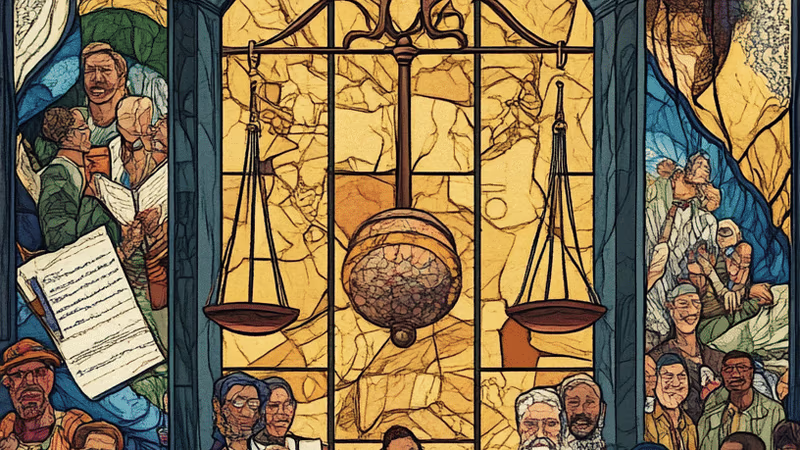 Employment discrimination and disability rights protection remain central concerns in American workplaces. This article examines how these two legal areas intersect and what employees should know about their rights.
Key Takeaway
Federal and New York State law provide overlapping protections for workers with disabilities — and New York's own statutes often go further than the ADA, covering more employers and a broader range of conditions.
Introduction
Discrimination in the workplace affects many Americans. It shows up in different ways, like gender and race bias. It can also involve unfair treatment based on disabilities.
Despite significant legal progress, workers with disabilities still face substantial barriers to equal employment opportunities. Knowing how employment discrimination law protects disabled workers helps create fair workplaces. It also empowers employers and employees to support these important rights.
Historical Development of Disability Rights
Before modern protections, workers with disabilities encountered widespread discrimination with little legal recourse. The Rehabilitation Act of 1973 marked the first major step forward, prohibiting disability discrimination in federal employment and federally funded programs.
Free Consultation · No Fee Unless We Win
Does this apply to your situation?
Every case is different. Get a free, confidential case review from an experienced attorney who can tell you exactly where you stand.
The Americans with Disabilities Act (ADA) of 1990 transformed disability rights protection. This landmark legislation established comprehensive civil rights safeguards for individuals with disabilities, particularly in employment settings. The ADA’s passage reflected growing recognition that disabled workers deserve equal access to career opportunities.
Employment Discrimination Law Framework
Federal and state laws prohibit workplace discrimination based on protected characteristics including race, color, religion, sex, national origin, age, and disability. For disabled workers, these protections cover all employment aspects:
- Hiring practices
- Promotion decisions
- Compensation
- Termination
- Workplace accommodations
- Training opportunities
- Benefits
The Equal Employment Opportunity Commission (EEOC) enforces these federal protections and investigates discrimination complaints.
Key Legislation Protecting Disabled Workers
Several major laws govern disability rights in employment:
Americans with Disabilities Act (ADA)
- Prohibits discrimination in public life including employment
- Requires reasonable workplace accommodations
- Protects qualified individuals with disabilities
- Covers employers with 15+ employees
Rehabilitation Act of 1973
- Bars discrimination in federal employment
- Protects workers in federally funded programs
- Section 504 provides additional civil rights protections
State Disability Laws
- Many states enacted stronger protections
- May cover smaller employers
- Often provide additional accommodations requirements
The ADA’s Impact on Workplace Rights
The ADA fundamentally changed how employers must treat disabled workers. Key requirements include:
- No discrimination in any employment decisions
- Limited pre-employment medical inquiries
- Reasonable accommodation requirements
- Confidentiality of medical information
- Interactive process for determining accommodations
While implementation challenges persist, the ADA created vital protections for millions of American workers with disabilities.
Notable Legal Cases
Several court decisions shaped current disability rights interpretation:
Sutton v. United Airlines (1999)
- Initially narrowed ADA disability definition
- Led to 2008 ADA Amendments Act expanding coverage
Toyota v. Williams (2002)
- Addressed essential job functions
- Clarified reasonable accommodation standards
These cases continue guiding how employment discrimination lawyers approach disability rights cases.
Current Enforcement Challenges
Despite legal protections, barriers remain:
- Lack of employer ADA knowledge
- Persistent disability discrimination
- Accommodation disputes
- Cost concerns
- Implementation difficulties
Employment lawyers and the EEOC play crucial roles addressing these issues through:
- Legal advocacy
- Discrimination complaint investigation
- Education initiatives
- Enforcement actions
Filing Discrimination Claims
Workers facing disability discrimination have several options:
- File an EEOC complaint
- Contact a discrimination lawyer
- Pursue state law remedies
- Consider wrongful termination claims
- Request reasonable accommodations
Time limits apply, so prompt action is important when experiencing discrimination.
Choosing Legal Representation
Employment discrimination cases involving disability rights require specialized legal knowledge. When selecting an attorney, consider:
- Experience with disability discrimination cases
- Knowledge of state and federal laws
- Track record of successful outcomes
- Understanding of medical conditions
- Ability to navigate EEOC procedures
The Law Office of Jason Tenenbaum, P.C. focuses on employment discrimination cases involving disability rights in NYC and Long Island. Their experienced employment lawyers understand both federal protections and New York state laws governing disability discrimination.
Conclusion
The intersection of employment discrimination law and disability rights continues evolving. While progress occurred, achieving truly equal employment opportunities requires ongoing commitment to:
- Legal enforcement
- Workplace education
- Accommodation implementation
- Rights advocacy
Understanding these protections helps ensure fair treatment for all workers. Those experiencing discrimination should consult qualified employment lawyers to protect their rights effectively.
Related Articles
Legal Context
Why This Matters for Your Case
Employment law in New York provides some of the strongest worker protections in the nation. The New York State Human Rights Law (Executive Law §296) prohibits discrimination based on race, sex, age, disability, sexual orientation, gender identity, and other protected characteristics. The New York City Human Rights Law goes even further, applying a broader standard and covering more employers.
Federal protections under Title VII, the ADA, the ADEA, and the FLSA provide additional layers of protection. The Law Office of Jason Tenenbaum represents employees facing workplace discrimination, wrongful termination, wage theft, hostile work environments, and employer retaliation throughout Long Island, Nassau County, Suffolk County, and the five boroughs of New York City.
Whether your case involves EEOC filings, NYS Division of Human Rights complaints, or direct court action under CPLR Article 78, this article provides the expert legal analysis that workers and practitioners need to understand their rights and develop effective litigation strategies under current New York employment law.
About This Topic
New York Employment Law
New York has some of the strongest worker protections in the nation — from the NYC Human Rights Law to state-level whistleblower statutes. Whether you're dealing with discrimination, wage theft, wrongful termination, or hostile work environments, understanding your rights is the first step. Attorney Jason Tenenbaum represents employees across Long Island and NYC in federal and state employment claims.
81 published articles in Employment Law
Keep Reading
More Employment Law Analysis

Religious Accommodation at Work After Bergin: The "Motivating Factor" Test in New York
The Second Circuit replaced its old religious-accommodation test with Abercrombie's motivating-factor test. What changed, what New York law adds, what to keep.
Oct 14, 2026
Does a New York Employer Have to Keep a Personnel File? What the Law Requires
No New York law says "keep a personnel file," but wage, I-9 and payroll rules already require one. What § 210-b adds on November 8, 2026.
Oct 13, 2026
New York's Trapped at Work Act: What Employees Need to Know About 2026 Changes
New York's amended Trapped at Work Act affects stay-or-pay clauses, training repayment agreements, and retention bonuses.
May 11, 2026
How Long Does an Employment Lawsuit Take?
How long does an employment lawsuit take in New York? Get a realistic timeline from filing through trial — plus what affects speed.
Mar 18, 2025
Where New York's 10-Day Personnel File Rule Came From: The Counseling Memo
Labor Law § 210-b gives every New York employee what teacher contracts have long given: notice of a write-up and a written answer in the file.
Oct 12, 2026
Shorted on a NY Public Job? Walton Says You Can Sue
New York's highest court ruled that public-works employees can sue for unpaid prevailing wages even when the contract omits the promise — and one-year.
Aug 9, 2026Frequently Asked Questions
Common Questions About This Topic
4 answers from the firm's New York personal-injury and employment-law practice. Click any question to expand.
What is the Americans with Disabilities Act and who does it protect in New York?
The ADA prohibits discrimination against qualified individuals with disabilities in employment, covering all employers with 15 or more employees. It requires employers to provide reasonable accommodations and prohibits adverse employment actions based on a worker's disability.
What constitutes a reasonable accommodation under the ADA?
Reasonable accommodations are modifications or adjustments that enable a qualified employee with a disability to perform essential job functions. Examples include schedule flexibility, remote work options, assistive technology, or modified duties — as long as they don't cause undue hardship to the employer.
How do I file a disability discrimination complaint in New York?
Workers may file a complaint with the EEOC within 180 days (or 300 days if state law also prohibits the discrimination) of the discriminatory act. New York also provides state-level remedies through the Division of Human Rights. Consulting an employment attorney promptly is advisable given strict time limits.
Does New York offer stronger disability protections than the federal ADA?
Yes. New York State Human Rights Law and New York City Human Rights Law generally provide broader protections than the ADA, including coverage of smaller employers (those with 4+ employees under state law) and a more expansive definition of disability.
Was this article helpful?
Disclaimer: This article is published by the Law Office of Jason Tenenbaum, P.C. for informational and educational purposes only. It does not constitute legal advice, and no attorney-client relationship is formed by reading this content. The legal principles discussed may not apply to your specific situation, and the law may have changed since this article was last updated.
New York law varies by jurisdiction — court decisions in one Appellate Division department may not be followed in another, and local court rules in Nassau County Supreme Court differ from those in Suffolk County Supreme Court, Kings County Civil Court, or Queens County Supreme Court. The Appellate Division, Second Department (which covers Long Island, Brooklyn, Queens, and Staten Island) and the Appellate Term (which hears appeals from lower courts) each have distinct procedural requirements and precedents that affect litigation strategy.
If you need legal help with a employment law matter, contact our office at (516) 750-0595 for a free consultation. We serve clients throughout Long Island (Huntington, Babylon, Islip, Brookhaven, Smithtown, Riverhead, Southampton, East Hampton), Nassau County (Hempstead, Garden City, Mineola, Great Neck, Manhasset, Freeport, Long Beach, Rockville Centre, Valley Stream, Westbury, Hicksville, Massapequa), Suffolk County (Hauppauge, Deer Park, Bay Shore, Central Islip, Patchogue, Brentwood), Queens, Brooklyn, Manhattan, the Bronx, Staten Island, and Westchester County. Prior results do not guarantee a similar outcome.