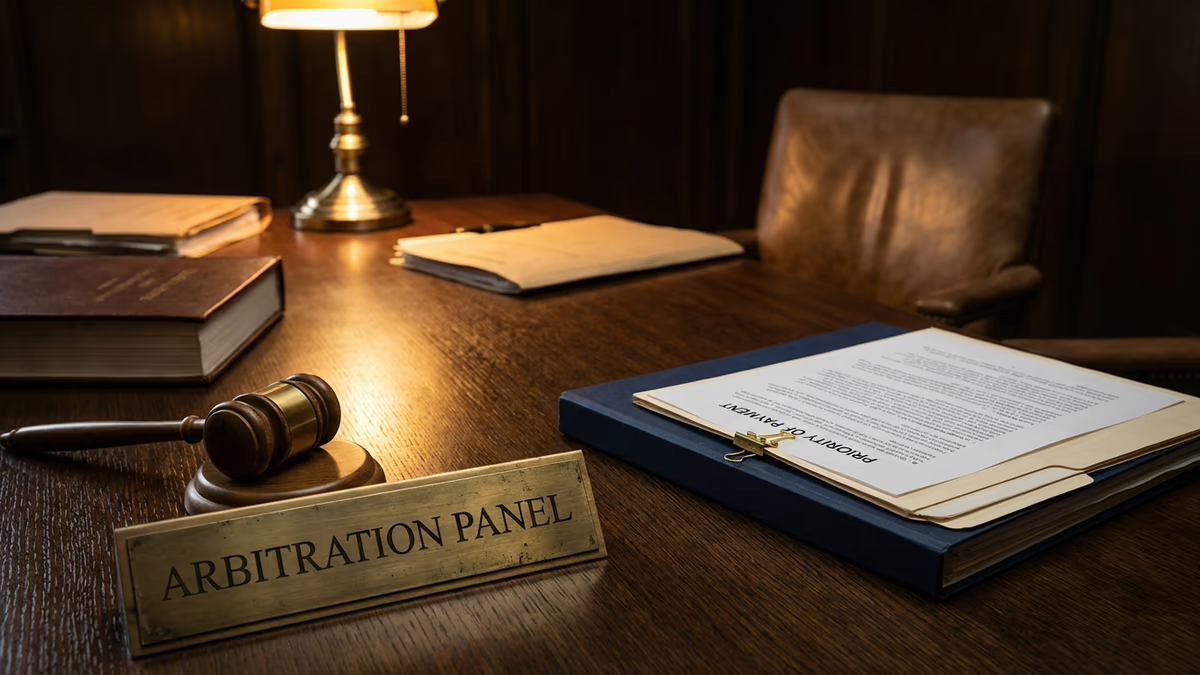
Why Trust This Analysis
This article is part of our ongoing no-fault coverage, with 271 published articles analyzing no-fault issues across New York State. Attorney Jason Tenenbaum brings 24+ years of hands-on experience to this analysis, drawing from his work on more than 1,000 appeals, over 100,000 no-fault cases, and recovery of over $100 million for clients throughout Nassau County, Suffolk County, Queens, Brooklyn, Manhattan, and the Bronx. For personalized legal advice about how these principles apply to your specific situation, contact our Long Island office at (516) 750-0595 for a free consultation.
Key Takeaways
- Insurance Law 5106(c) allows either the insurer or the claimant to bring a court action de novo when a master arbitration award is $5,000 or more, exclusive of interest and attorney’s fees.
- The de novo action wipes the slate clean: the arbitration result has no preclusive weight, and the dispute is litigated from scratch in court.
- Carriers sometimes file de novo actions purely as settlement leverage after losing twice in arbitration — and too many provider-side attorneys reward the tactic.
- In a properly litigated de novo, the carrier usually holds the weaker hand: it bears the burden on its defenses and holds most of the relevant documentation.
If I were to use this blog for advertising purposes, I would recommend consulting with me if you receive a PIP trial de novo. It is a side business and I have seen some of the most interesting behaviors..
The Statutory Framework: What Insurance Law 5106(c) Provides
A quick orientation for anyone who landed here without a no-fault background. New York’s no-fault law gives an injured person or their assignee medical provider a choice of forums: sue in court, or elect arbitration under Insurance Law 5106(b). If the claimant elects arbitration and either side is unhappy with the award, the next stop is master arbitration — a limited, record-based review of the original arbitrator’s decision.
Insurance Law 5106(c) supplies the final escape hatch. Where the master arbitrator’s award is $5,000 or more, exclusive of interest and attorney’s fees, either the insurer or the claimant may institute a court action to adjudicate the dispute de novo. “De novo” means exactly what it says: the court action is a fresh, plenary lawsuit. The arbitration awards below — even two wins in a row — carry no preclusive effect. Everything is back on the table: the provider’s prima facie case, the carrier’s defenses, discovery, and ultimately a trial.
Free Consultation · No Fee Unless We Win
Does this apply to your situation?
Every case is different. Get a free, confidential case review from an experienced attorney who can tell you exactly where you stand.
Below the $5,000 threshold, the master arbitration award is binding, subject only to the narrow Article 75 grounds for vacatur. That dollar line is why de novo actions cluster around big-ticket claims — surgical bills, hospital claims, and stacked treatment ledgers.
Where the Statute Gets Abused
But, on a more serious note, when an insurance carrier uses a de novo action for no reason other than to force settlements, you know the statute is not being properly applied. But I put the blame on the arb attorneys who will actually negotiate disadvantageous settlements after they won twice. If I am an insurance carrier and I see that behavior, my more venal side might ask you to prove yourself. My worst day is an 80-50 settlement. The good faith side of me would shy away from these absent a legitimate reason. I believe I always have a legitimate reason to dive down the de-novo train.
The economics explain the behavior. A de novo action converts a finished arbitration into the start of a Supreme Court lawsuit, with answer deadlines, discovery, and motion practice. A provider’s attorney who is built for arbitration volume — not litigation — sees years of carrying costs ahead and discounts accordingly. The carrier, meanwhile, has already priced the claim and loses little by filing. That asymmetry, not the merits, is what drives many post-award settlements at a fraction of the award.
Litigating the De Novo: Who Really Holds the Cards
And that brings me to something else. If you can figure out how to properly litigate one of these suckers, the insurance carrier should usually lose, with minimal provider based discovery. Why? Who holds the cards in these cases? Who bears the burdens of proof? Who has the relevant documentation? Who has the skeletons on the closet?
Walk through the burdens. The provider’s prima facie case in a no-fault billing dispute is modest — proof that the statutory claim forms were submitted and that payment is overdue. The heavy lifting belongs to the carrier: a precluded or unpreserved defense is gone, and the carrier must prove timely denials, proper verification practices, and the substantive merits of whatever defense survived. The claim file, the mailing logs, the peer review file, the adjuster’s notes — all of it sits in the carrier’s cabinet, which means the carrier is the party exposed in discovery, not the provider.
A provider’s attorney who treats the de novo as a real lawsuit — serving targeted discovery on the carrier, moving on preclusion, and pressing for trial — flips the settlement leverage. The carrier that filed to extract an 80-50 settlement now has to produce its skeletons or pay the award.
Why This Matters
For medical providers, the lesson is simple: a de novo summons is not a reason to discount a claim you have already won twice. For carriers, the lesson is discipline — the statute exists for genuinely disputed, high-value awards, and a de novo filed purely for leverage invites a court to scrutinize the entire claim file. For claims professionals, the burden allocation, not the award size, should drive the decision to file.
The de novo also fits a larger theme in no-fault practice: forum and procedure often decide these cases before the merits do, just as with summary judgment timing under CPLR 3212.
Practice Pointers
- Calendar the threshold. The de novo right exists only where the master arbitration award is $5,000 or more, exclusive of interest and attorney’s fees. Below that, Article 75 is the only review.
- Treat the de novo as a plenary action. Answer, demand discovery of the carrier’s claim file and mailing practices, and litigate preclusion. Do not negotiate from the arbitration posture.
- Providers: resist reflexive discounts. Two wins in arbitration cost the carrier nothing in court — but the carrier’s proof problems carried over too.
- Carriers: file for reasons, not leverage. A de novo without a genuine defense theory is an invitation to lose a third time, this time with a judgment.
Related Resources
- A formulation of a prima facie case (Legal Encyclopedia hub)
- Browse the firm’s Legal Encyclopedia for the full no-fault litigation library
- No-fault defense practice
- Understanding CPLR 3212(g) paradigm for summary judgment
- Critical timing rules for summary judgment motions in New York
- No-fault verification requirements and partial compliance issues
- Understanding reasonable excuse and default judgment scenarios
- New York No-Fault Insurance Law
Related: What “de novo” means in New York — trial de novo and de novo review, explained.
Legal Context
Why This Matters for Your Case
New York's no-fault insurance system, established under Insurance Law Article 51, is one of the most complex insurance frameworks in the country. Every motorist must carry Personal Injury Protection coverage that pays medical expenses and lost wages regardless of fault, up to $50,000 per person.
But insurers routinely deny valid claims using peer reviews, EUO scheduling tactics, fee schedule reductions, and coverage defenses. The Law Office of Jason Tenenbaum has handled over 100,000 no-fault cases since 2002 — from initial claim submissions through arbitration before the American Arbitration Association, trials in Civil Court and Supreme Court, and appeals to the Appellate Term and Appellate Division. Jason Tenenbaum is one of the few attorneys in the state who both writes his own appellate briefs and tries his own cases.
His 2,600+ published legal articles on no-fault practice are cited by attorneys throughout New York. Whether you are dealing with a medical necessity denial, an EUO no-show defense, a fee schedule dispute, or a coverage question, this article provides the kind of detailed case-law analysis that helps practitioners and claimants understand exactly where the law stands.
About This Topic
New York No-Fault Insurance Law
New York's no-fault insurance system requires every driver to carry Personal Injury Protection (PIP) coverage that pays medical expenses and lost wages regardless of who caused the accident. But insurers routinely deny, delay, and underpay valid claims — using peer reviews, IME no-shows, and fee schedule defenses to avoid paying providers and injured claimants. Attorney Jason Tenenbaum has litigated thousands of no-fault arbitrations and court cases since 2002.
271 published articles in No-Fault
Keep Reading
More No-Fault Analysis

Car Accident Recorded Statement in New York: Should You Give One?
The at-fault driver's adjuster wants a recorded statement within days of a New York car accident — and that call is designed to weaken your case.
Apr 5, 2026
Who Pays Car Accident Medical Bills in New York? A Step-by-Step Guide
New York no-fault PIP, primary health insurance, Medicaid/Medicare, and litigation liens — the full payment ladder for car-accident medical bills.
Apr 5, 2026
Pre and post claim EUO
Understanding when insurance companies can schedule examinations under oath in no-fault cases, whether before or after claim submission, based on recent court decisions.
Mar 17, 2021
Venue Motion Under CPLR 511: Where It Must Be Brought in New York
CPLR 511 venue transfer motions: the 15-day deadline after a contested demand and why the safer practice is filing in the plaintiff's chosen county.
May 4, 2015
Emergency Doctrine – A normally stoic appellate division appears to be letteing loose (a bit)
The NY Appellate Division delivers an unexpectedly candid ruling on the emergency doctrine, showing rare judicial personality in a motor vehicle collision case.
Feb 1, 2010
Untimely 4404(a) motion
Court reinstated $1.2M verdict after defendants' untimely CPLR 4404(a) motion failed due to missing 15-day deadline without good cause shown for delay.
Apr 18, 2022Frequently Asked Questions
Common Questions About This Topic
3 answers from the firm's New York personal-injury and employment-law practice. Click any question to expand.
What is a trial de novo under Insurance Law 5106(c)?
It is a brand-new court action that either the insurer or the claimant may bring after no-fault master arbitration, available only when the master arbitrator's award is $5,000 or more, exclusive of interest and attorney's fees. The court hears the dispute from scratch.
Does winning in no-fault arbitration matter if the insurer files a de novo action?
Legally, no — the prior awards are not preclusive. Practically, yes — the proof problems that cost the carrier the arbitration usually follow it into court, where discovery against the carrier's claim file is broader.
Can a master arbitration award under $5,000 be challenged in court?
Not by trial de novo. Awards below the threshold are binding and reviewable only on the narrow CPLR Article 75 grounds.
Was this article helpful?
Disclaimer: This article is published by the Law Office of Jason Tenenbaum, P.C. for informational and educational purposes only. It does not constitute legal advice, and no attorney-client relationship is formed by reading this content. The legal principles discussed may not apply to your specific situation, and the law may have changed since this article was last updated.
New York law varies by jurisdiction — court decisions in one Appellate Division department may not be followed in another, and local court rules in Nassau County Supreme Court differ from those in Suffolk County Supreme Court, Kings County Civil Court, or Queens County Supreme Court. The Appellate Division, Second Department (which covers Long Island, Brooklyn, Queens, and Staten Island) and the Appellate Term (which hears appeals from lower courts) each have distinct procedural requirements and precedents that affect litigation strategy.
If you need legal help with a no-fault matter, contact our office at (516) 750-0595 for a free consultation. We serve clients throughout Long Island (Huntington, Babylon, Islip, Brookhaven, Smithtown, Riverhead, Southampton, East Hampton), Nassau County (Hempstead, Garden City, Mineola, Great Neck, Manhasset, Freeport, Long Beach, Rockville Centre, Valley Stream, Westbury, Hicksville, Massapequa), Suffolk County (Hauppauge, Deer Park, Bay Shore, Central Islip, Patchogue, Brentwood), Queens, Brooklyn, Manhattan, the Bronx, Staten Island, and Westchester County. Prior results do not guarantee a similar outcome.