Key Takeaway
New Way Acupuncture: an apparently premature notarization defeated the insurer's motion, but the provider's judgment was reversed too.
This article is part of our ongoing affidavits coverage, with 19 published articles analyzing affidavits issues across New York State. Attorney Jason Tenenbaum brings 24+ years of hands-on experience to this analysis, drawing from his work on more than 1,000 appeals, over 100,000 no-fault cases, and recovery of over $100 million for clients throughout Nassau County, Suffolk County, Queens, Brooklyn, Manhattan, and the Bronx. For personalized legal advice about how these principles apply to your specific situation, contact our Long Island office at (516) 750-0595 for a free consultation.
Last reviewed: September 2026.
Historical note: This ruling concerns the affidavit submitted under the earlier procedure; current CPLR 2106 permits a subscribed perjury affirmation for covered statements without eliminating every oath or acknowledgment requirement.
Both summary judgment motions ultimately failed in New Way Acupuncture v New York Central Mutual, 53 Misc 3d 141(A) (2016). A facial problem with the insurer’s second IME no-show affidavit was one reason its motion failed; the provider’s separate proof did not justify its judgment either.
What the affidavit showed
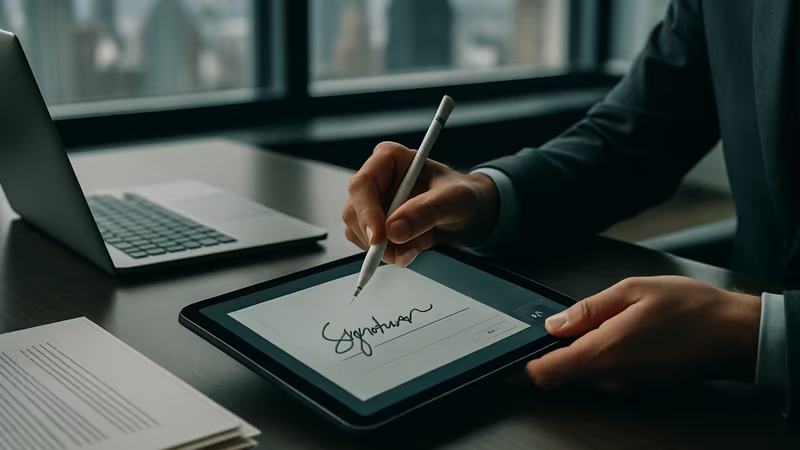
The affidavit concerning the second missed examination appeared, on its face, to have been notarized before it was signed. The Appellate Term identified that problem among the insurer’s failures to establish nonappearance at duly scheduled IMEs. It left denial of the insurer’s motion in place.
Free Consultation · No Fee Unless We Win
Does this apply to your situation?
Every case is different. Get a free, confidential case review from an experienced attorney who can tell you exactly where you stand.
The provider had obtained summary judgment below, but its cross-motion proof did not establish the necessary insufficiency in the insurer’s denial. The appellate court reversed the resulting judgment and denied that cross motion. Losing a no-show motion did not automatically establish the provider’s right to payment.
The opinion does not establish a photocopy rule
Jason wondered how the apparent sequence could have occurred. The published decision does not answer that question or find that someone used a photocopied signature. CPLR 2101(e) generally permits copies to be served or filed unless otherwise prescribed. The practical check is whether the submitted proof records a valid oath or affirmation and supports the facts asserted, not whether every signature appears in original ink.
Jason’s original comment
Jason’s original question follows. The opinion does not identify photocopied signatures or explain how the dating discrepancy arose.
This is an interesting one. The notarization occurred before the signature? I am guessing the affiant’s signature was an original and the notary signature was a photocopy? How was this determined?
Connect to the Encyclopedia
Start with the CPLR 2106 affirmations and affidavits hub for the current procedure and its historical cases.
- Eagle Surgical: chiropractor peer reviews under the former rule
- Clarke: conformity and notarial attestation are separate defects
- Quality Psychological: former signer restrictions and two failed motions
- McMullin: medical proof offered in an improper surreply
- American Casualty: a curable certificate omission on a dismissal motion
For review of a particular document or motion record, contact the firm. This note is general information, not an assessment of a pending case.
Legal Context
Why This Matters for Your Case
New York law is among the most complex and nuanced in the country, with distinct procedural rules, substantive doctrines, and court systems that differ significantly from other jurisdictions. The Civil Practice Law and Rules (CPLR) governs every stage of civil litigation, from service of process through trial and appeal. The Appellate Division, Appellate Term, and Court of Appeals create a rich and ever-evolving body of case law that practitioners must follow.
Attorney Jason Tenenbaum has practiced across these areas for over 24 years, writing more than 1,000 appellate briefs and publishing over 2,600 legal articles that attorneys and clients rely on for guidance. The analysis in this article reflects real courtroom experience — from motion practice in Civil Court and Supreme Court to oral arguments before the Appellate Division — and a deep understanding of how New York courts actually apply the law in practice.
Keep Reading
More Affidavits Analysis
Who is the attorney?
Civil Kings court case on attorney representation requirements and default judgment appeals in no-fault insurance litigation.
Feb 1, 2020
Understanding Affidavit and Translation Requirements in NY Employment Law Cases
Watabe accepted English affidavits after Japanese-interpreted depositions. See what it decided and what CPLR 2101(b) still requires for translations.
Jan 17, 2019
When an Affidavit Really Is Not an Affidavit: Caption and Attestation Defects in New York
New Millennium: an insufficient psychologist affidavit, limits of form-defect waiver, and the current fifteen-day rule under CPLR 2101(f).
Jul 14, 2011
Substantive fee schedule discussion/Procedural analysis
Analysis of Gentle Acupuncture v Tri-State Consumer Insurance case examining fee schedule defenses and affidavit requirements in New York no-fault claims.
Jun 10, 2017
Defective notarization
Clarke v Scottsdale: a curable conformity omission differed from a defective notarial attestation. The insurer's motion remained denied.
Nov 16, 2014
Peer hearsay and electronic signatures
Appellate court rules on peer review requirements and electronic signature validity in no-fault insurance disputes, clarifying evidence standards for medical necessity challenges.
May 25, 2012Frequently Asked Questions
Common Questions About This Topic
3 answers from the firm's New York personal-injury and employment-law practice. Click any question to expand.
Is an affidavit valid if it was notarized before it was signed?
In New Way, that facial defect was one reason the insurer failed to establish its IME no-show defense on summary judgment. The opinion does not announce that every discrepancy has the same consequence.
Why do IME no-show motions depend so heavily on affidavits?
They supply evidence of scheduling and nonappearance. The court examined the insurer's proof, including its second no-show affidavit. Current CPLR 2106 also permits compliant affirmations for covered statements; execution alone does not establish the facts.
What should I check when reviewing an opponent's affidavit?
Read the statement, supporting records, signature and oath or affirmation together, including inconsistent dates. New Way made no photocopy finding, and CPLR 2101(e) generally permits copies unless otherwise prescribed.
Was this article helpful?
Disclaimer: This article is published by the Law Office of Jason Tenenbaum, P.C. for informational and educational purposes only. It does not constitute legal advice, and no attorney-client relationship is formed by reading this content. The legal principles discussed may not apply to your specific situation, and the law may have changed since this article was last updated.
New York law varies by jurisdiction — court decisions in one Appellate Division department may not be followed in another, and local court rules in Nassau County Supreme Court differ from those in Suffolk County Supreme Court, Kings County Civil Court, or Queens County Supreme Court. The Appellate Division, Second Department (which covers Long Island, Brooklyn, Queens, and Staten Island) and the Appellate Term (which hears appeals from lower courts) each have distinct procedural requirements and precedents that affect litigation strategy.
If you need legal help with a affidavits matter, contact our office at (516) 750-0595 for a free consultation. We serve clients throughout Long Island (Huntington, Babylon, Islip, Brookhaven, Smithtown, Riverhead, Southampton, East Hampton), Nassau County (Hempstead, Garden City, Mineola, Great Neck, Manhasset, Freeport, Long Beach, Rockville Centre, Valley Stream, Westbury, Hicksville, Massapequa), Suffolk County (Hauppauge, Deer Park, Bay Shore, Central Islip, Patchogue, Brentwood), Queens, Brooklyn, Manhattan, the Bronx, Staten Island, and Westchester County. Prior results do not guarantee a similar outcome.